 By thinkzone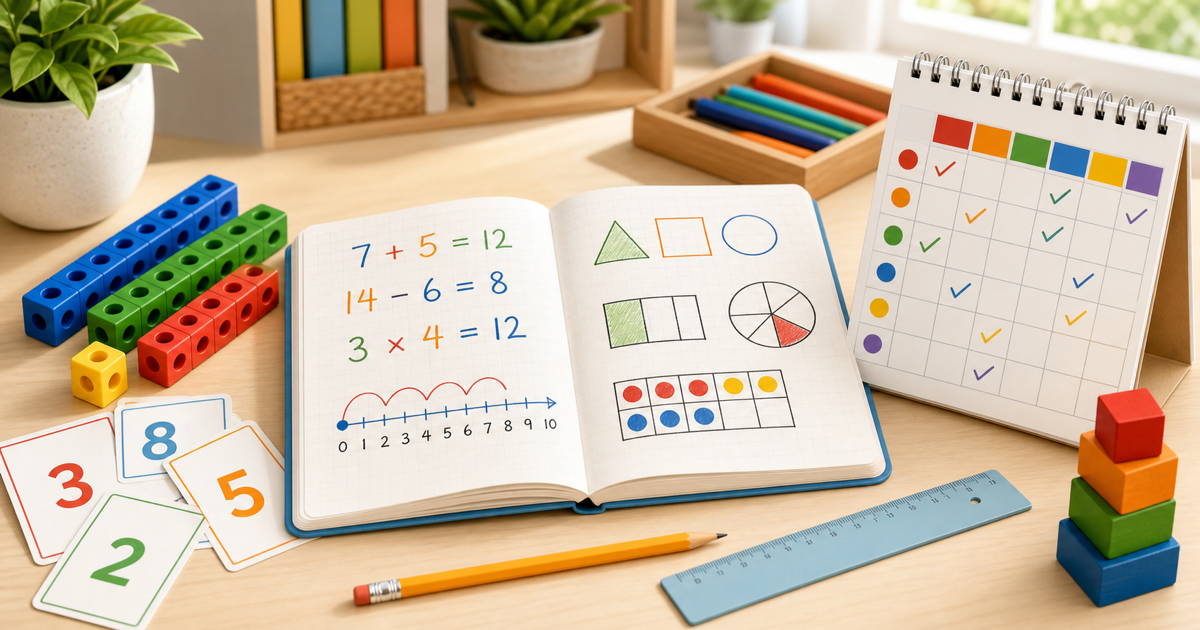
Strong math skills are built through small, consistent moments—not marathon worksheet sessions. When families create simple math habits at home, children get more opportunities to reason, explain their thinking, and see how numbers connect to everyday life.
The good news is that you do not need to be a math expert or redesign your family schedule. A few low-pressure routines can help K–8 learners practice important skills while building confidence. Here are seven practical ways to get started.
Why math habits at home matter
Children learn best when practice is predictable and meaningful. A regular routine reduces the effort of deciding when to study, while real-life examples help abstract ideas feel useful. Over time, these habits can encourage persistence, flexible thinking, and a healthier response to challenging problems.
1. Start with a predictable 10-minute routine
Choose a time that already fits your day, such as after a snack, before screen time, or while dinner is being prepared. Keep the first sessions short—about 10 minutes is enough. Consistency matters more than duration.
Give the routine a clear beginning and ending. For example, solve one warm-up problem, practice one current skill, and finish with a quick reflection: “What felt easier today?” A simple structure helps children know what to expect and makes the habit easier to maintain.
2. Connect math to everyday decisions
Daily life is full of natural math practice. Invite your child to compare prices at the store, estimate how long a trip will take, double a recipe, sort laundry by size, or calculate how many minutes remain before an activity.
Adjust the question to your child’s level. Younger learners might count objects or compare quantities. Older learners can work with fractions, percentages, rates, or unit prices. These conversations show that math is a tool for making sense of the world—not only a school subject.
3. Ask “How did you think about it?”
A correct answer is useful, but the reasoning behind it tells you much more. Ask open questions such as:
- How did you get started?
- Can you solve it another way?
- What information is most important?
- How could you check your answer?
Let your child finish explaining before offering a correction. Even an incomplete strategy can reveal useful ideas. When children put their thinking into words, they become more aware of the steps they use and where they may need help.
4. Treat mistakes as useful information
Mistakes are a normal part of learning, but children may interpret them as proof that they are “bad at math.” Shift the conversation from judgment to investigation. Try saying, “Let’s find the step where the answer changed,” or “What does this mistake teach us?”
Parents can model this mindset too. If you make an error, calmly correct it out loud. Showing that adults revise their thinking makes productive struggle feel safer and helps children stay engaged when a problem is difficult.
5. Use objects, drawings, and symbols
If a problem feels confusing, represent it in a different way. Coins, blocks, measuring cups, number lines, diagrams, and quick sketches can make relationships easier to see. After your child understands the idea with a visual or physical model, connect it back to the equation or mathematical symbols.
Moving between representations builds flexible understanding. It also gives children more than one way to approach unfamiliar problems—an especially valuable habit as math becomes more abstract.
6. Celebrate strategies and progress
Notice the behaviors that lead to learning, not only speed or perfect scores. Specific feedback is most helpful: “You checked your work carefully,” “That diagram made the problem clearer,” or “You stayed with it even when the first strategy did not work.”
You can also keep a small progress log. Once a week, ask your child to write one skill that feels stronger and one question they still have. This makes growth visible and gives you a simple way to choose the next practice activity.
7. Choose practice that matches the learner
Practice should be challenging enough to require thought but not so difficult that every question ends in frustration. If your child is stuck, return to a smaller prerequisite skill or work through one example together. If the work is consistently easy, add a twist by asking for another method, a real-world example, or an explanation.
When confusion continues across several sessions, write down the specific type of problem and discuss it with your child’s teacher or learning instructor. Focused information makes it easier to identify the missing concept and provide the right support.
A simple weekly math routine
You can turn these ideas into a manageable weekly plan:
- Monday: Review one skill from school.
- Tuesday: Use math during cooking, shopping, or planning.
- Wednesday: Solve one problem in two different ways.
- Thursday: Play a number, logic, or strategy game.
- Friday: Reflect on one success and one next step.
Keep the plan flexible. Missing a day does not erase progress; simply return to the routine at the next convenient time. Sustainable math habits at home should support family life, not create additional pressure.
Final thoughts
Building math confidence is a gradual process. Short routines, thoughtful questions, real-life connections, and a positive response to mistakes can make practice more meaningful. Start with one habit this week, observe how your child responds, and adjust from there.
For more practical K–8 math and ELA learning guidance, explore the latest resources from Think Zone.