 By thinkzone
Solving a new problem requires students to notice structure, test an approach, and adapt when the first idea does not fit. Photo via Pexels.
If your child can follow math steps but can’t solve new problems, the missing ability may be transfer. The student can reproduce a demonstrated procedure while the page looks familiar, yet does not know which idea applies when the numbers, wording, representation, or unknown changes.
Transfer grows when students explain why steps work, compare methods, identify the structure of a problem, and practice with purposeful variation. Giving another identical example may improve imitation. It does not necessarily teach the child how to choose or adapt a method independently.
Math Transfer at a Glance: A student must recognize when and why a method applies, not only repeat it.
Imitation: The child follows a visible example or memorized sequence.
Understanding: The child can explain the meaning of the steps.
Flexibility: The child can compare and choose among methods.
Transfer: The child uses the idea when surface details change.
Best diagnostic: Change one feature and ask what still stays true.
Best teaching move: Use explanation, comparison, and varied practice.
Avoid: Do not equate a completed example with independent mastery.
Why worked examples can create an illusion of mastery
A worked example reduces the decisions a student must make. The method, order, and often the notation are already visible. This support is useful while learning, but it can hide whether the child recognizes the underlying concept.
After an example, ask the child to cover it and explain the purpose of each step. Then change one feature. If the child restarts by searching for a matching page, the strategy may still be tied to surface cues.
Three signs of a transfer gap
The student asks which formula or operation to use
This question often means the child has a menu of procedures but no way to choose among them. Ask what quantities are related, what is unknown, and which representation would make the relationship visible before naming an operation.
Another sign is success only when problems appear in the same order as the lesson. Mixed practice removes the sequence cue and reveals whether the student can identify the problem type independently.
The student cannot explain or adapt a step
A memorized procedure may fall apart when a number is replaced with a variable, a diagram is rotated, or the unknown moves. Ask the child to solve in another way or explain which step would change. The response shows whether the procedure is connected to meaning.
The IES problem-solving guide for Grades 4 through 8 recommends helping students monitor and reflect, use visual representations, compare multiple strategies, and connect mathematical concepts and notation to problem solving.
Use an example-explain-vary-transfer cycle
Choose one worked example that is clear and accurate. Do not remove support all at once. Instead, ask for explanation, then vary the problem gradually until the child must choose the method without a matching model.
Use this four-step progression:
- Example: study a worked solution and identify the goal of each step.
- Explain: cover the solution and reconstruct why the method works.
- Vary: change the numbers, representation, context, or location of the unknown.
- Transfer: mix the problem with other types and let the child choose a method.
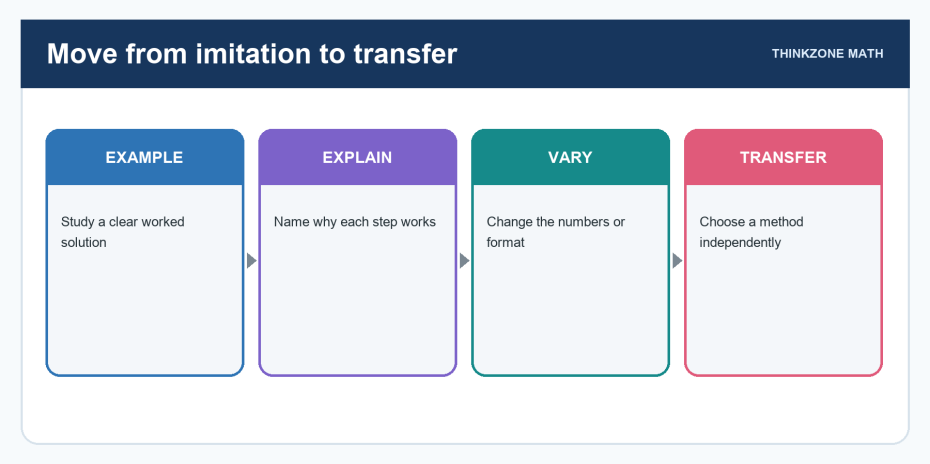
A gradual move from example to explanation, variation, and independent choice helps reveal whether understanding can transfer. Graphic created for ThinkZone.
Compare problems by structure, not appearance
Place two problems side by side and ask what is mathematically the same and what is different. One may use money and the other distance, yet both may involve the same proportional relationship. This comparison directs attention to structure.
The IES elementary guide also emphasizes deliberate work with word-problem types and representations. Students benefit when they connect stories, diagrams, equations, and solution methods instead of treating each format as a separate trick.
How much help should an adult give?
Give the smallest prompt that restarts thinking. Ask, “What do you know?” “What are you trying to find?” or “Which earlier problem has the same structure?” Avoid choosing the operation or completing the next step unless you are explicitly teaching it.
Then fade the prompt on a similar problem. A student has not yet transferred the method if the same cue is required every time. Track whether the child can generate the question independently.
ThinkZone’s math habits at home guide includes prompts that encourage explanation and multiple approaches. The ThinkZone Math program can use the same evidence to adjust a personalized K-8 learning plan.
A useful rule for parents
After a child completes a demonstrated method, change one feature and ask, “What still stays true?”
That question shifts attention from the exact page to the mathematical relationship. It also makes transfer visible before a high-stakes test does.
When an assessment can help
Consider an assessment when the child repeatedly needs a matching example, cannot choose a method in mixed work, or loses a procedure as soon as the format changes. A ThinkZone assessment can identify the concepts and prerequisites that support more flexible problem solving.
Assessment results should lead to targeted practice, not a label. The aim is to find a productive starting point and then use explanation, variation, feedback, and review to build independence.
Frequently Asked Questions
Is following steps a bad way to learn math?
No. Worked examples and explicit steps can reduce overload during early learning. The student also needs explanation and varied practice so the method is not tied to one page.
How can I tell whether my child understands a procedure?
Ask why each step is valid, request a model, and change one feature. Understanding is more likely when the child can explain and adapt.
Should my child learn multiple methods?
Multiple methods can build flexibility when the student has enough prior knowledge. Start with one clear method, then compare alternatives for meaning and efficiency.
Why does mixed practice feel harder?
Mixed practice removes the cue about which method to use. That difficulty gives the child practice choosing, which is part of independent problem solving.
What is a good transfer question?
Ask, “How is this problem like the one you solved before, and how is it different?” The answer should refer to mathematical structure, not only the topic or nouns.
How can ThinkZone help with transfer?
ThinkZone can assess current skills and use tutor questions, paper-based work, and varied practice to build conceptual understanding and strategy choice. The ThinkZone FAQ explains the process.
Move from copying a method to choosing one
If a new format makes a familiar skill disappear, the next step should build transfer. Schedule a ThinkZone assessment or read the ThinkZone FAQ to learn how personalized math support begins.