 By thinkzone
A math mistake is useful evidence when a child slows down, finds its source, and chooses a better checking habit. Photo by KATRIN BOLOVTSOVA via Pexels.
When a child makes careless mistakes in math, “careless” describes the result but not the cause. The error may begin with a missed word, an unstable procedure, crowded written work, rushing, weak fact fluency, or a habit of stopping as soon as an answer appears.
The most effective response is to classify a few errors before assigning more practice. If most mistakes come from setup, a checking checklist will not teach the missing concept. If the concepts are secure but signs and units are skipped, a short self-monitoring routine may help.
Careless Math Mistakes at a Glance: Replace the label “careless” with a specific error category.
Reading error: The child misses a word, sign, unit, or part of the question.
Setup error: The model, equation, or operation does not match the task.
Procedure error: The plan is sound, but a fact or step breaks down.
Notation error: Digits, signs, labels, or alignment become unclear.
Checking error: The child does not test whether the answer is reasonable.
Best evidence: Review original work across several assignments.
Best response: Teach one routine for the dominant error type.
Why the word careless can hide the real problem
Two students can both lose points on a subtraction problem. One copied 64 as 46. The other still confuses regrouping. The first needs a recording habit; the second needs instruction. Treating both as inattention wastes time and can make the child feel blamed.
Collect three to five recent examples. Keep the original markings. Ask the child to talk through each problem without fixing it first. Listen for the moment when the written work stops matching the intended reasoning.
Common causes of repeated math errors
Rushing, overload, and weak organization
Some children work too quickly because they want the task to end. Others rush because basic facts or procedures are not automatic enough, so a multistep problem overloads attention. Crowded handwriting and missing labels can also cause a student to lose place.
Slow work is not automatically careful work. A child may spend a long time while repeating the same misconception. Look for the type and location of the error rather than using speed alone as the explanation.
Conceptual gaps that look like slips
A repeated sign error may show confusion about negative numbers. A misplaced decimal may reflect weak place-value understanding. An answer without a unit may come from not understanding what the quantity represents. Repetition in the same category is a clue that teaching, not reminding, is needed.
The Common Core Standards for Mathematical Practice include attending to precision, but precision is more than neatness. Students need to communicate meaning, use symbols consistently, calculate accurately, and judge whether results make sense.
Build a short error-checking routine
Choose a routine that fits on a small card or at the top of a page. Use it for a few problems at a time until the steps become familiar. A long checklist creates another task to manage.
Try this four-part routine:
- Read: circle the question and mark units or signs that matter.
- Set up: write a model or equation before calculating.
- Compute: keep digits aligned and show enough work to find an error.
- Check: estimate, verify the sign and unit, and reread the question.
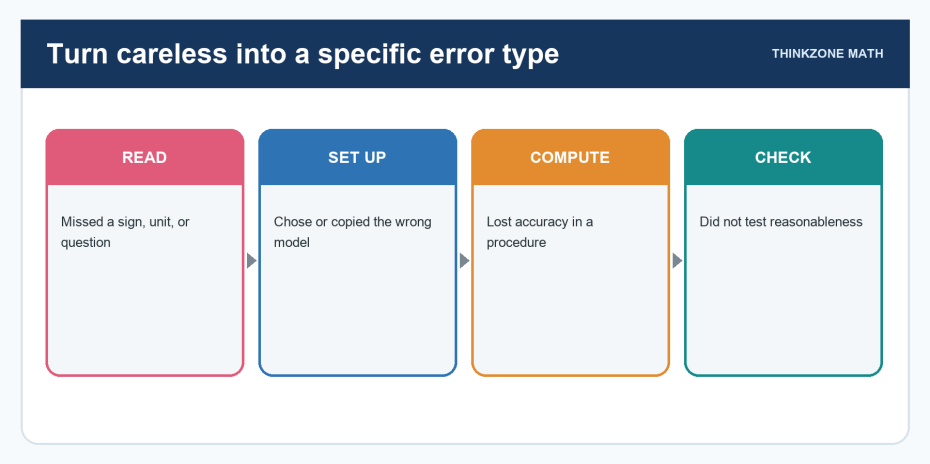
A specific four-part review is more useful than telling a child to “be careful.” Graphic created for ThinkZone.
Use an error log without turning it into punishment
An error log can be a small table with the date, skill, error type, correction, and one sentence about what to do next time. Review patterns once a week. Do not require a long written reflection after every small slip.
Praise the correction process, not a perfect page. A useful comment is, “You noticed the unit did not fit and fixed it.” ThinkZone’s math habits guide has more ways to make checking and explanation part of a normal routine.
Match the response to the error pattern
Reading errors may call for marking the question. Setup errors may need a diagram. Procedure errors may need a smaller prerequisite lesson. Notation errors may improve with graph paper or clearer spacing. Checking errors may need estimation and a final reread.
If the child makes different errors every time, reduce the task length and observe attention, fatigue, and working conditions. If errors cluster around one concept, reteach that concept with a model and explanation.
ThinkZone Math uses paper-based work and tutor observation to locate patterns. The personalized K-8 math program can combine focused correction with the next appropriate skill rather than repeating an entire grade level.
A useful rule for parents
Replace “You knew this” with “Show me where your plan and your paper stopped matching.”
That wording treats the mistake as information. It also helps distinguish an attention slip from a concept or procedure that is not yet secure.
When to seek additional support
Talk with the teacher when errors persist across subjects, affect classroom participation, or come with strong frustration. A ThinkZone assessment may help if the pattern points to math prerequisites, strategy choice, or written problem solving.
Do not use an educational article to diagnose attention, vision, anxiety, or a learning disability. If the concern is broad or significant, ask the child’s school and an appropriate qualified professional about next steps.
Frequently Asked Questions
Are careless math mistakes a sign of low ability?
No. Many causes are possible, including rushing, weak procedures, unclear notation, working conditions, and missing checking habits. Review patterns before making a broad judgment.
Should I make my child redo the whole worksheet?
Usually start with the relevant errors. Redoing every correct item can create frustration without teaching the missing habit or concept.
How can I tell a slip from a misconception?
A slip is often inconsistent and the child can explain and correct it quickly. A misconception tends to repeat in the same concept and survives reminders to check.
Does working more slowly solve the problem?
Sometimes, but not by itself. Teach a specific pause point, such as checking the operation before calculating or estimating before writing the final answer.
What should go in an error log?
Record the skill, the error category, the corrected work, and one short prevention step. Review patterns weekly rather than after every question.
How can ThinkZone help?
ThinkZone can use an assessment and written work to identify prerequisite gaps and recurring error patterns, then adjust practice and tutor prompts. See the ThinkZone FAQ for program details.
Turn repeated mistakes into useful evidence
A specific error pattern leads to a more specific plan. Schedule a ThinkZone assessment to review your child’s current math skills, or read the ThinkZone FAQ before choosing support.