 By thinkzone
Accurate calculation is useful, but students must also connect numbers to a situation, model, and equation. Photo by Max Fischer via Pexels.
If your child knows math facts but struggles with word problems, the missing skill is usually not another round of fact practice. Fact fluency helps a student calculate. A word problem also asks the student to understand a situation, recognize a quantity relationship, represent it, and decide which operation fits.
A child can know that 7 x 8 = 56 and still be unsure whether a story calls for multiplication, division, addition, or comparison. The useful question is not “Does my child know the facts?” It is “Can my child connect the story to a mathematical model?”
Math Facts and Word Problems at a Glance: Fact fluency supports calculation, but it does not choose the equation.
What facts show: The child can retrieve or compute a numerical result.
What word problems add: The child must interpret, model, choose, solve, and check.
Common missing link: The relationship among the quantities is not yet clear.
Best diagnostic: Give the same numbers as a bare equation and as a story.
Best teaching move: Connect the story, a visual model, and the equation.
Avoid: Do not respond only with more speed drills.
When to seek help: The gap persists across several problem types or grades.
Fluency and problem solving are different competencies
The IES mathematical problem-solving protocol separates procedural knowledge, conceptual knowledge, and procedural flexibility. That distinction explains why a student may calculate correctly in one format but struggle to choose or adapt a method in another.
Math facts reduce the amount of attention needed for basic calculation. That matters. Still, fluency cannot replace comprehension. A student must decide what the numbers represent and how those quantities are connected before a fact can be used well.
What may be missing when facts are strong
The child sees numbers but not the relationship
Ask your child to cover the numbers and describe the story. If the explanation stays vague, the student may be scanning for numbers instead of building a mental model. Use objects or a diagram to show equal groups, comparison, change, or part-whole relationships.
Then reveal the numbers and ask what each one measures. This step matters because the same operation can appear in many contexts, and the same context can sometimes be represented in more than one way.
The child knows a procedure but not when it applies
Some students recognize a familiar worksheet layout, yet a new story removes the visual cue. Ask, “Why does multiplication fit here?” or “What would change if the unknown were the group size?” A strong answer refers to the quantities, not to a keyword.
Mathematical language can be another bottleneck. Terms such as per, each, difference, remaining, or altogether should be connected to situations and models. Memorizing a vocabulary definition is not enough if the child cannot use it in context.
Run a two-format check at home
Choose arithmetic your child knows well. Present it first as an equation and then as a short story with the same numbers. Keep the computation easy so you can observe the translation step.
Compare the child’s response across four questions:
- Can the child solve the bare equation accurately?
- Can the child retell the story without reading it word for word?
- Can the child draw the relationship among the quantities?
- Can the child explain why the equation matches the drawing?
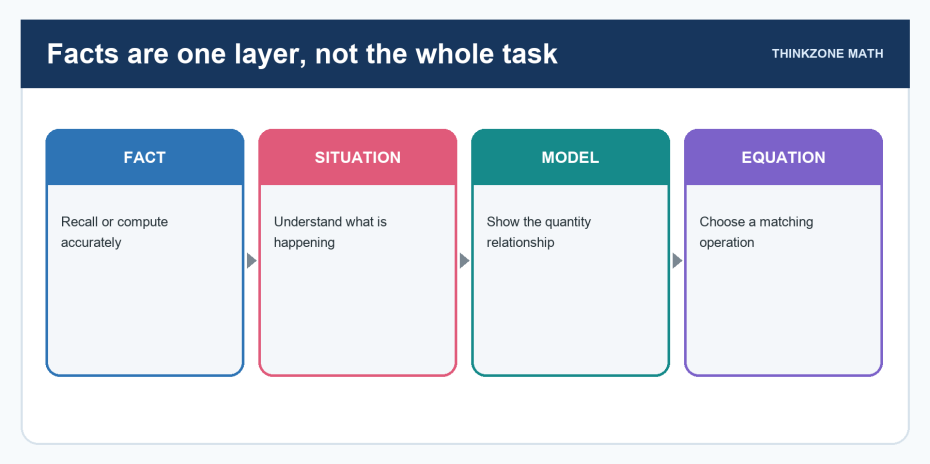
Fact recall is only one layer of a word problem. The student must still interpret the situation, represent the relationship, and build an equation. Graphic created for ThinkZone.
How to build the missing connection
The IES elementary mathematics guide recommends mathematical language, representations, and deliberate instruction on word problems. Practice should connect concrete or visual models to symbols instead of jumping directly from a paragraph to an operation.
ThinkZone Math uses written work, tutor questions, and an assessed starting point. A student who knows facts may need fewer repetitive calculations and more opportunities to explain, model, compare, and solve unfamiliar problems. Learn more about the personalized K-8 math program.
Practice for transfer, not only recognition
Keep the mathematical structure the same while changing the surface details. A problem about boxes can become a problem about rows of chairs. Ask the child what stayed the same. This draws attention away from the nouns and toward the relationship.
You can also ask for two representations: a diagram and an equation, or objects and a number sentence. ThinkZone’s math habits at home guide offers more ways to make reasoning visible without turning family time into a long lesson.
If your child’s classroom uses a particular visual model or textbook sequence, review the teacher’s examples. The South Bay curriculum guide can help local families understand common program language, but the child’s own work should drive the diagnosis.
A useful rule for parents
If the arithmetic is easy but the story is hard, lower the calculation demand and investigate the meaning.
That keeps the child from being mislabeled as careless or weak in facts. It also shows whether the next lesson should focus on language, modeling, problem type, or operation choice.
When an assessment can help
An assessment is useful when the child solves familiar equations but repeatedly guesses on stories, depends on an adult to choose the operation, or cannot explain why a method fits. Schedule a ThinkZone assessment to map current strengths and missing prerequisites.
Bring examples that use the same operation in different formats. The contrast helps a teacher or tutor see whether the difficulty is calculation, language, representation, or transfer.
Frequently Asked Questions
Does fact fluency still matter?
Yes. Reliable facts free attention for planning and reasoning. The problem is assuming that fluency alone teaches a child how to interpret and model a situation.
Should we stop fact practice?
Not necessarily. Keep fact practice brief and appropriate, then spend time connecting facts to models and stories. The balance should reflect the child’s actual need.
Why does my child pick numbers and guess an operation?
The student may not yet recognize the relationship among the quantities. Ask for a retelling and a diagram before allowing an equation.
Are keywords useful at all?
They can draw attention to language, but they should not act as automatic operation rules. The full situation determines the mathematics.
What is a good sign of conceptual understanding?
The child can explain why a method works, connect a model to an equation, and adapt when the numbers or context change.
How can ThinkZone support this gap?
ThinkZone Math can use assessment results and written work to separate strong fluency from weak modeling or operation choice, then adjust the learning plan. The ThinkZone FAQ explains the general process.
Connect the facts to the thinking
If calculation is strong but problem solving is not, the next step should target meaning, not just speed. Schedule a ThinkZone assessment or review the ThinkZone FAQ to see how personalized math support begins.