 By thinkzone
A calm review of written work can reveal whether test difficulty begins with recall, pacing, interpretation, or checking. Photo by Ron Lach via Pexels.
When a child understands math at home but fails tests, the difference is often in the conditions, not in intelligence or effort. Homework may include notes, examples, parent prompts, extra time, or immediate correction. A test asks the student to retrieve, choose, and monitor strategies independently.
Before adding more worksheets, compare the two settings. Ask what help was available at home, how long the child took, whether the test was timed, and which errors appeared. The pattern can point to weak retrieval, incomplete independence, test anxiety, format changes, or a specific skill gap.
Home-to-Test Gap at a Glance: The same child may perform differently when cues, time, and pressure change.
Hidden support: Examples or small prompts may be doing more work than anyone realizes.
Retrieval gap: The child recognizes a method in notes but cannot recall it alone.
Time pressure: Rushing can reduce planning and checking.
Anxiety: Worry can compete with the attention needed for multistep work.
Format: Mixed or unfamiliar items may expose weak strategy choice.
Best evidence: Compare the actual test with independent untimed work.
Next step: Target the cause instead of assigning generic review.
First, measure how independent the home performance is
A child may genuinely understand after a parent says, “Look at yesterday’s example,” or asks, “What operation comes next?” Those prompts are useful during learning. They also mean the work is not yet independent. On a test, the student must generate the cue.
Try one short problem without notes, hints, or correction. Ask the child to explain the first move before calculating. If the child cannot begin, the issue may be retrieval or strategy selection rather than the final computation.
Four reasons test performance may drop
Retrieval, timing, and mixed problem types
Recognition feels easier than recall. Seeing a worked example can make a method seem familiar, while a blank test page requires active retrieval. The IES study guide recommends active retrieval, spaced review, and using tests or quizzes to identify material that needs more study.
Tests also mix problem types. A child who practiced ten identical items may not know which method to choose when addition, fractions, geometry, and word problems appear together. Mixed practice can feel harder during study, but it gives the student practice choosing a strategy.
Anxiety and the test environment
Math anxiety and performance are related, but a low score does not prove anxiety. A 2022 meta-analysis found a negative association among math anxiety, working memory, and math performance. Worry may use attention that the child needs for planning and calculation, especially on complex tasks.
Look for evidence: stomachaches before tests, blanking on familiar material, unusually fast work, skipped pages, or a large difference between timed and untimed performance. Discuss recurring distress with the teacher and, when appropriate, a qualified health professional.
Use a three-version comparison
Choose a small set of problems from the same unit. Keep the content similar, but change the amount of support and time. Record accuracy, starting time, skipped steps, and checking behavior.
Compare these four conditions:
- Solve one problem with notes and explain each step.
- Solve a similar problem without notes and without a time limit.
- Solve a mixed set without notes after a short delay.
- Review errors by type: recall, setup, calculation, or checking.
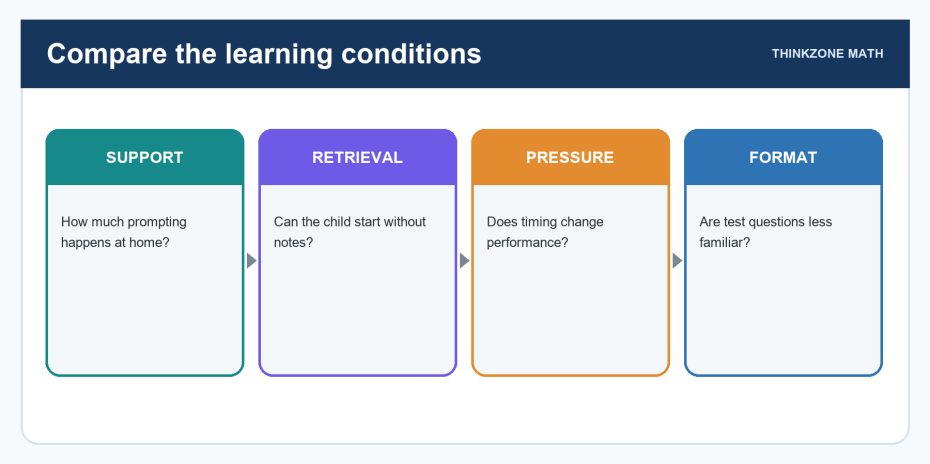
Comparing support, retrieval, pressure, and format helps parents identify why homework and test results may not match. Graphic created for ThinkZone.
How to prepare for tests without cramming
Space review across several days. Close the notes and retrieve a method from memory. Mix a few older skills with the current unit. Ask the child to explain why a method applies, then include one unfamiliar-looking problem. These moves build independence more directly than rereading a solution.
Keep the final review calm and short. Sleep, school routines, and teacher expectations matter too. ThinkZone’s math habits at home guide offers practical routines that do not depend on a long last-minute worksheet session.
Read the error pattern, not only the score
A test score combines many events. Separate conceptual errors from forgotten facts, copied signs, skipped questions, and unfinished work. One low test may be noise. The same error pattern across several assessments is more informative.
Ask the classroom teacher whether the child shows understanding during discussion and independent work. Also ask how much of the test was timed, whether problems were cumulative, and whether corrections are allowed. Those details help you compare like with like.
Local curriculum and pacing can affect the format of review. Bay Area parents can use ThinkZone’s South Bay math curriculum guide as background, while relying on the teacher and the child’s papers for current classroom expectations.
A useful rule for parents
Do not treat a calm, supported homework session as proof that the skill is ready for independent retrieval.
Support is part of learning. The goal is to fade it deliberately, then see whether the child can choose and carry out the method without the cue.
When an assessment can clarify the gap
Consider an assessment when test scores remain much lower than independent untimed work, the same prerequisite keeps reappearing, or the child cannot explain what changed. A ThinkZone assessment can map current skills and help distinguish a content gap from a practice or independence gap.
ThinkZone Math combines an assessed learning plan with paper-based work, tutor guidance, and progress reporting. Review the K-8 math program to see how ongoing work can be adjusted as a learner progresses.
Frequently Asked Questions
Does a failed test mean my child did not understand the unit?
Not necessarily. The result may reflect retrieval, time, format, anxiety, or a specific error pattern. Compare the test with independent work before drawing a broad conclusion.
How can I tell whether I help too much on homework?
Notice whether you choose the first step, point to examples, correct errors immediately, or ask leading questions. Try one similar problem with no prompts and observe where the child stops.
Should my child practice under a timer?
Use timing carefully. First confirm the student can solve accurately without pressure. Short, low-stakes timed practice may help with fluency, but it should not replace conceptual work or increase distress.
What if my child says the mind goes blank?
Ask when it happens and what the body feels like. Share recurring concerns with the teacher. If anxiety is frequent or intense, seek advice from an appropriate qualified professional.
What should we review after a math test?
Sort errors into categories: misunderstood question, wrong plan, forgotten fact or procedure, calculation error, skipped step, or no check. Then practice the smallest relevant skill.
Can ThinkZone help with test-performance gaps?
ThinkZone can assess current math skills and observe written problem solving. The plan can then target missing prerequisites, independent retrieval, or strategy choice. The ThinkZone FAQ provides more program details.
Turn the score into a clearer next step
A test score is a signal, not a diagnosis. Schedule a ThinkZone assessment to compare strengths, gaps, and independent problem solving, or read the ThinkZone FAQ before your visit.