 By thinkzone
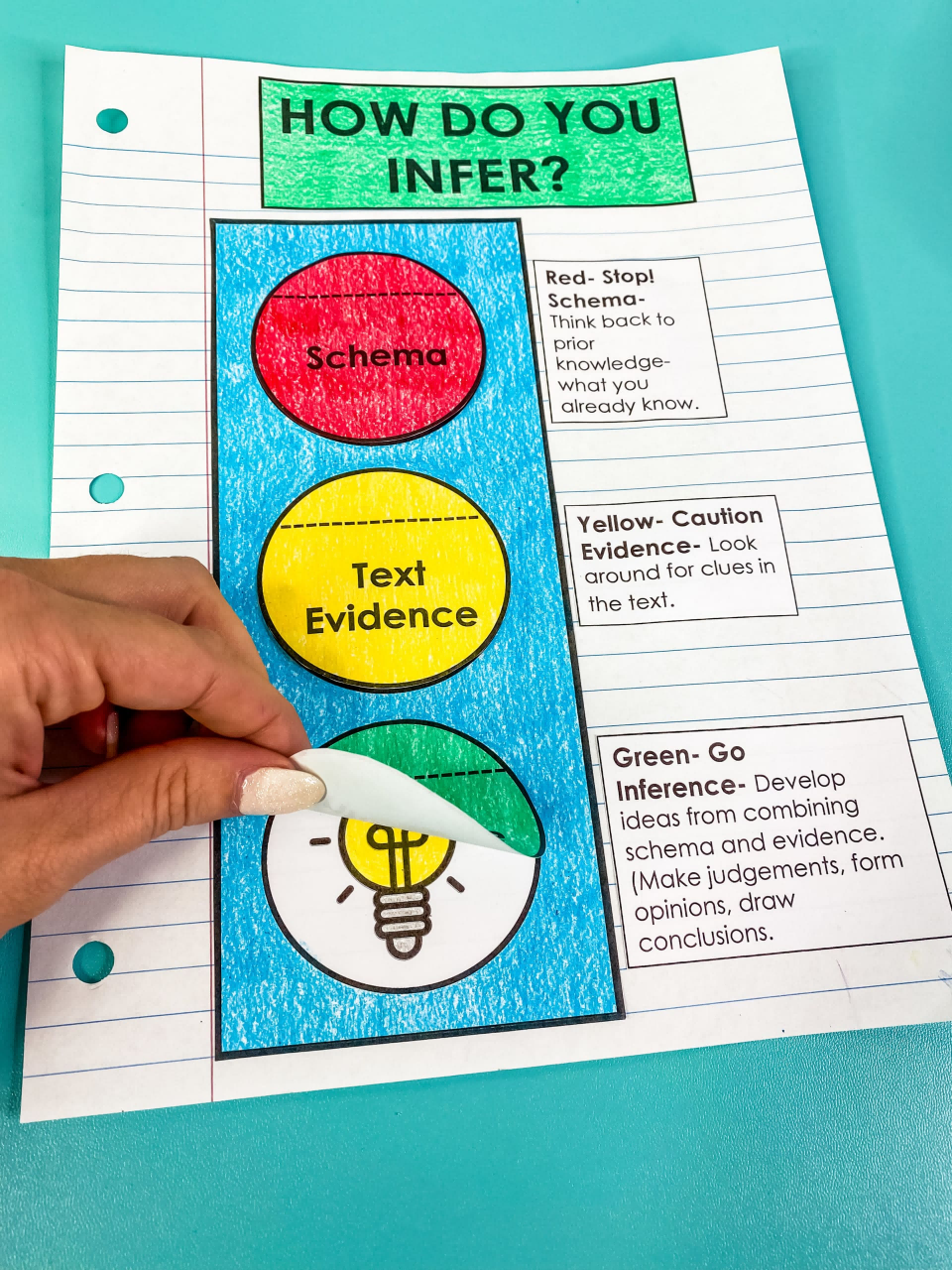
An inference in reading is a conclusion you reach by connecting clues in the text with relevant knowledge, even though the author does not state the conclusion directly.
Here’s a simple example:
Ava twisted the lid again. It didn’t move. She carried the jar to her dad and held it out.
Why does Ava bring the jar to her dad?
You probably think she wants help opening it. The passage never says, “Ava asked for help.” You work that out from her unsuccessful attempts and what she does next.
That is an inference.
When a teacher asks children to “read between the lines,” this is the kind of thinking they mean. For a child, though, that phrase may need an explanation of its own. The examples below give you a more concrete way to show what to do.
How Does Making an Inference Work?
Start with three questions:
- What does the text tell us?
- What do we know that helps explain those details?
- What conclusion fits?
In Ava’s case, the text tells us the lid will not move and she takes the jar to her dad. We know that people sometimes ask someone else for help when a lid is stuck. Those details support the conclusion that Ava wants help opening it.
The Institute of Education Sciences describes inferencing as generating information needed to understand a text when that information is not explicitly stated. Its teaching guidance recommends helping children identify relevant clues, connect them with knowledge, and explain their conclusions. Explore the IES reading comprehension toolkit.
The connection to the passage matters. “Ava wants to paint the jar purple” is imaginable, but nothing in these sentences supports it.
Inference vs. Prediction: What’s the Difference?
A prediction is about what might happen next. An inference can help explain something already happening, something that happened earlier, or an unstated reason.
An evidence-based prediction can also be a kind of inference. The distinction below is a useful way to explain the terms during reading:
| Type of response | Example from Ava’s story |
| A stated detail | Ava carries the jar to her dad. |
| An inference | Ava wants help opening the jar. |
| A prediction | Her dad might try to open it. |
A prediction does not have to come true to have been reasonable. Perhaps Dad cannot open the jar either. Readers can revise their ideas as the story continues.
You do not need to spend much time testing the labels. Ask your child what they think and which details helped them reach that idea.
Four Inference Examples to Try With Your Child
These short passages were written for practice. Read one together, ask the question, and give your child time to think before sharing the possible answer.
The answers show reasonable interpretations. Your child may have another explanation worth discussing.
1. Inferring a Character’s Feelings
Ben stood beside the front door with his backpack on. He checked the clock again. “Is it time to leave yet?” he asked for the third time.
Ask: How might Ben be feeling?
A possible answer: Ben may be eager or impatient to leave.
Clues to discuss: He is already wearing his backpack, keeps checking the time, and has asked repeatedly about leaving.
If your child says “nervous,” explore that:
“What makes you think he might be nervous?”
That answer could fit, too. You might need more of the story to decide whether Ben is excited about an outing or worried about being late.
Avoid treating one action as proof of a particular emotion. Checking a clock can mean different things in different situations.
2. Inferring Why Someone Does Something
Owen squinted at the small print in his book. He switched on the lamp and moved his chair closer to it.
Ask: Why does Owen move closer to the lamp?
A possible answer: He wants more light so he can see the print better.
Clues to discuss: He is squinting at small print, turns on a light, and moves toward it.
If your child answers, “Because he wanted to move,” help connect the actions:
“What was Owen having trouble with just before he moved?”
The question directs attention to a reason already suggested by the passage.
3. Inferring What Happened Between Two Moments
Sam left a scoop of ice cream in a bowl on the warm kitchen counter. After lunch, he returned to find a sweet, sticky puddle in the bowl.
Ask: What happened to the ice cream?
A possible answer: It melted.
Clues to discuss: The ice cream was left somewhere warm, time passed, and it became a puddle.
This example depends on knowing that ice cream melts when it gets warm. If your child does not make that connection, explain it:
“Ice cream needs to stay cold to keep its shape. What happens when it warms up?”
Then reread the passage together. Sometimes the missing piece is knowledge that an adult takes for granted.
4. Inferring Someone’s Intention
Priya made a birthday card for her brother. While he was outside, she slipped it into his backpack and smiled. She didn’t mention it when he came back.
Ask: Why might Priya keep the card a secret?
A possible answer: She probably wants to surprise her brother when he finds it.
Clues to discuss: She puts the card where he will discover it, does so while he is away, and does not tell him afterward.
You could follow up with:
“What would change if Priya handed him the card and said, ‘Look what I made’?”
That comparison helps your child think about why the author included the quiet, secret actions.
How to Help When Your Child Says “I Don’t Know”
Repeating “Make an inference” usually gives a stuck reader very little to work with. Show them a specific connection instead.
Literacy researcher Timothy Shanahan emphasizes directing students toward identifiable information and relationships, such as causes and character motivations, rather than simply asking them to infer. Read his discussion of teaching inferencing.
Here are a few ways to make that practical at home.
Point to One Useful Detail
For Owen’s story, try:
“Let’s look at the first sentence. What is Owen doing with his eyes?”
Once your child notices that he is squinting, connect it to what he does next.
Choose one clue to begin with. Asking several new questions at once may make the task harder.
Say Your Thinking Out Loud
Model a short explanation:
“Owen is having trouble seeing the print. Then he turns on a lamp. I think he moves closer because the light helps him see.”
Afterward, invite your child to try a different example. They have heard what connecting the details sounds like.
Check the Words and Situation
Does your child understand squinted? Do they know why someone might wear a backpack before leaving?
Explain unfamiliar language or situations before returning to the inference question. A child cannot easily reason from a clue they do not understand.
Offer a Sentence Starter
Try:
“I think ___ because the story says ___.”
For example:
“I think Priya wants to surprise him because she hides the card and doesn’t tell him.”
Use the starter as support when needed. A clear answer in your child’s own words works just as well.
What If Your Child Gives a Different Answer?
Ask:
“Which part helped you think that?”
Then consider the whole passage together.
If your child thinks Ben is worried about being late, that fits his repeated checking of the time. If they think he dislikes his backpack, ask where the passage suggests that.
Sometimes there is enough evidence for several interpretations. Sometimes one explanation fits much better. It is also reasonable to say:
“We don’t have enough information yet. Let’s keep reading.”
Reading Rockets’ guidance on inferencing emphasizes supporting conclusions with evidence and reconsidering them when new information appears. See its inferencing guide.
Changing an answer after noticing another clue is useful reading work.
Bring Inference Questions Into Your Regular Reading
You do not need a separate worksheet every evening. Choose a moment in a book when an important reason, feeling, or connection is left unstated.
A few useful questions are:
- “Why do you think she did that?”
- “What probably happened between these two parts?”
- “What does this action suggest about what he wants?”
- “Which detail helped you work that out?”
Keep the book open. Your child can point, reread, or talk through an idea.
For a younger child, read the passage aloud and let them answer orally. For a more experienced reader, ask whether another explanation could fit and which one the text supports best.
One thoughtful exchange can be enough. Once the connection makes sense, return to the story.
Frequently Asked Questions
How do you explain inference to a child?
Try: “An inference is something you work out from clues, even though the author doesn’t say it directly.” Follow with a short example, such as Ava holding out a jar after she cannot open it.
Is an inference just a guess?
An inference should have support. Your child should be able to identify a detail or connection that makes the answer reasonable. A guess without supporting clues may be possible, but the passage gives you little reason to choose it.
Can an inference be wrong?
Yes. A reader may miss a clue or use knowledge that does not fit the situation. New information can also change an earlier interpretation. Looking back and revising an answer are part of understanding a text.
Can children practice inference before they read independently?
Yes. You can read a short passage aloud or discuss a scene in a picture book. Ask what your child notices and what those details suggest. They can explain their thinking without writing an answer.
Why can my child answer “what happened” but struggle with “why”?
“What happened” may be directly stated. “Why” may require connecting actions, understanding a character’s goal, or supplying relevant knowledge. Help your child find the specific relationship rather than repeatedly asking the same question.
The next time a character does something unexpected, pause for one question: “What might explain that?” Find a clue together, talk through the connection, and see what the next part of the story reveals.