 By thinkzone
Math struggles by grade level can look very different from kindergarten through middle school. A second grader may rely on counting for problems that call for place-value strategies. A fifth grader may remember the steps for adding fractions but struggle to explain why equivalent fractions are needed. A seventh grader may calculate accurately but have trouble connecting a ratio to a table, graph, and equation. These are different problems, and they usually need different kinds of support. California’s math standards describe what students should know and be able to do at each grade, but a grade label by itself does not identify which prerequisite skill an individual child has or has not mastered.
That is why “behind in math” is often too broad to be useful. A better starting point is to locate the point where the learning chain becomes uncertain.
Common Math Struggles by Grade Level: K–8 Breakdown
The Common Core State Standards for Mathematics show how math learning progresses across grade levels, from early number sense and operations to fractions, proportional reasoning, and algebra.
Math builds cumulatively. The purpose of looking at math struggles by grade level is not to label a child as “ahead” or “behind.” It is to identify which earlier idea may be making current work harder.
The table below summarizes several high-leverage points in the California K–8 math progression. It is not a diagnosis or a ranking of the most common difficulties.
| Grade range | Important skills in the progression | What a sticking point may look like |
|---|---|---|
| K–2 | Number sense, place value, addition and subtraction, early equal-group thinking | Counts everything from the beginning, has trouble explaining tens and ones, or can calculate only when a familiar method is shown |
| Grade 3 | Multiplication and division meaning, fact relationships, word problems, early fraction concepts | Knows some facts but cannot explain equal groups, connect multiplication to division, or model a simple fraction |
| Grades 4–5 | Fraction equivalence, fraction operations, decimals, multistep reasoning | Follows fraction rules without understanding equivalence, confuses decimal place value, or loses track of relationships in multistep problems |
| Grades 6–8 | Ratios, rates, proportional relationships, multiple representations, linear equations | Can calculate individual steps but struggles to connect tables, graphs, equations, and real-world relationships |
These bands reflect the progression in California’s grade-level math standards: Grade 2 emphasizes place value and addition/subtraction strategies; Grade 3 formalizes multiplication and division; Grades 4 and 5 build fraction equivalence, decimal understanding, and fraction operations; and Grades 6 through 8 develop ratio reasoning, proportional relationships, and linear equations.
Kindergarten to Grade 2: Number Sense, Place Value, and Early Arithmetic
In the early grades, the goal is not only to produce correct answers. Children are building the number relationships that later written methods depend on.
By Grade 2, California standards expect students to use place-value understanding and properties of operations to add and subtract. Students work within 100 fluently and also use models, drawings, place-value strategies, and written methods for addition and subtraction within 1,000. Grade 2 also introduces equal groups and rectangular arrays as foundations for multiplication.
A child may therefore appear successful on simple worksheets while still relying on a fragile strategy.
For example, consider 47 + 25.
A child who understands place value can see 40 + 20 and 7 + 5, or decompose the numbers another reasonable way. A child who treats every digit as an isolated symbol may be able to copy a written algorithm without understanding why regrouping works.
The same distinction appears in subtraction. The important question is not simply whether the child can write the answer. Ask:
“Why did you regroup?”
“Can you show this with tens and ones?”
“Can you solve it another way?”
One strategy is not automatically better than another. The useful signal is whether the child can connect quantities, representations, and operations.
Counting on fingers is also not, by itself, evidence that a child has a math problem. Fingers can be a useful representation. What matters is whether the child is gradually developing more efficient strategies and can explain the quantities involved.
Early word problems deserve attention for the same reason. California’s first-grade standards already ask students to solve addition and subtraction situations using objects, drawings, and equations. A child may therefore calculate 8 + 5 correctly while still having difficulty deciding that a story represents addition.
Grades 3 to 5: Multiplication, Division, Fractions, and Decimals
Grade 3 marks an important transition from primarily additive thinking toward multiplication and division. California standards ask students to interpret products as equal groups, interpret quotients as sharing or grouping situations, solve multiplication and division word problems, and understand the relationship between the two operations.
That means knowing that 6 × 4 = 24 is useful, but it is not the whole skill.
Ask a child:
“What does 6 × 4 mean?”
“Can you draw it as equal groups or an array?”
“If 6 × 4 = 24, what does 24 ÷ 6 tell you?”
A student who can recall 24 but cannot connect the multiplication and division relationships may have fact knowledge without the same level of conceptual understanding.
This difference becomes especially visible in word problems. A child may know multiplication facts but still be unsure whether a situation involves equal groups, comparison, sharing, or another structure. Think Zone’s related guide, “My Child Knows Math Facts but Struggles With Word Problems,” focuses specifically on this gap between calculation and mathematical modeling.
Fractions then become increasingly important.
In Grade 4, California standards develop fraction equivalence and ordering, ask students to justify fraction comparisons, and connect fractions with denominators of 10 and 100 to decimal notation. In Grade 5, students use equivalent fractions as a strategy for adding and subtracting fractions with unlike denominators.
This progression explains why a fifth-grade fraction problem can expose a fourth-grade gap.
Suppose a child is trying to solve:
1/2 + 1/4
If the child knows only that they need a “common denominator,” ask a more basic question first:
“Why is 1/2 the same amount as 2/4?”
If the child cannot show the equivalence with a drawing, number line, or numerical explanation, harder fraction practice may not address the underlying issue. That is an inference from the standards progression: Grade 5 fraction addition explicitly depends on creating equivalent fractions, while fraction equivalence is developed earlier.
Decimals create a similar test of place-value understanding. Grade 4 standards connect fractions with denominators of 10 or 100 to decimal notation and require students to compare decimals based on their values. A child who reads 0.62 as a string of digits without connecting it to sixty-two hundredths may have more difficulty when decimal operations become more complex.
The useful question in Grades 3–5 is therefore not only, “Can my child complete the procedure?” It is also, “Can my child explain the relationship that makes the procedure work?”
Grades 6 to 8: Ratios, Proportional Relationships, and Algebra Readiness
Middle-school math asks students to express relationships in increasingly abstract ways.
In Grade 6, California standards emphasize ratio and rate reasoning. Students work with equivalent-ratio tables, diagrams, number lines, equations, unit rates, percentages, and coordinate graphs.
A student may be able to compute 3 × 4 = 12 and still struggle with the statement:
“Three notebooks cost $12. What is the cost per notebook?”
The arithmetic is simple. The challenge is identifying the relationship between quantities and understanding what the unit rate represents.
Grade 7 pushes that reasoning further. Students determine whether relationships are proportional, identify constants of proportionality in tables, graphs, equations, diagrams, and verbal descriptions, and represent proportional relationships with equations.
That creates a new kind of difficulty. A child may understand a table but not recognize the same relationship in a graph. Or the child may calculate the unit rate correctly but not understand why an equation such as y = 3x represents the same relationship.
By Grade 8, students are solving linear equations in one variable, including equations that require distributing and combining like terms.
The apparent “algebra problem” may therefore begin earlier.
If a student struggles with an equation that contains fractions, the bottleneck may be fraction arithmetic rather than algebraic reasoning. If the student cannot interpret slope or a linear relationship, the missing link may involve earlier ratio and proportional reasoning.
This is why repeating only the current chapter is not always the most efficient response. Current work can reveal an older prerequisite that deserves attention first.
How to Tell Whether Your Child Has a Math Skill Gap
One difficult worksheet or one low test score does not identify a learning gap. Look for a repeated pattern: the same concept causes trouble across different numbers, formats, or assignments.
The checks below are simple observations, not diagnostic tests. They are designed to help parents describe a problem more precisely before talking with a classroom teacher or learning provider.
K–2 Parent Check
- Place value: Ask your child what the tens and ones digits represent in an age-appropriate number.
- Addition and subtraction: Watch whether they use a strategy or restart counting from one every time.
- Problem-solving: Try a simple problem using objects, a drawing, or an equation.
- Mathematical reasoning: After solving a problem, invite your child to explain why the answer makes sense instead of simply saying, “That’s the rule.”
These checks align with early California standards that emphasize place value, strategies, models, drawings, and mathematical explanation.
Grade 3 Parent Check
- Multiplication: Use an expression such as 4 × 6 and ask your child to show it as equal groups or an array.
- Division: Explore how a multiplication fact connects to a related division fact.
- Word problems: Present a simple equal-groups story and see whether your child chooses multiplication or division.
- Fractions: Ask your child to explain a basic fraction as a number or quantity, rather than just naming its numerator and denominator.
Grade 3 standards emphasize the meaning of multiplication and division and the relationship between these operations. Students also begin developing an understanding of fractions as numbers.
Grades 4–5 Parent Check
- Equivalent fractions: Ask why 1/2 and 2/4 represent the same quantity.
- Comparing numbers: Have your child compare two fractions or decimals and explain the reasoning.
- Visual understanding: See whether a fraction procedure connects to a visual model or number line.
- Multi-step problems: After each step, ask what the calculation is intended to find.
These checks reflect the move from fraction equivalence and decimal understanding in Grade 4 to operations with unlike denominators and broader fraction reasoning in Grade 5.
Grades 6–8 Parent Check
- Ratios and rates: Ask your child to explain a ratio or unit rate using a real-world example.
- Proportional relationships: Explore how the same relationship appears in a table, graph, and equation.
- Constant of proportionality: Have your child explain what the constant represents.
- Linear equations: Give your child an equation to solve, then check the answer by substitution.
California’s middle-school standards explicitly move among ratio tables, coordinate graphs, equations, proportional relationships, and linear equations.
A particularly useful home check is to change the format without changing the underlying math.
For example, give a child a familiar equation and then a word problem using the same numbers. If the equation is easy but the story is difficult, the issue may involve mathematical language, modeling, or operation choice rather than calculation itself. Think Zone’s existing word-problem resources use this same distinction between computation and representation.
The goal is to make the problem more specific:
Not: “My child is bad at fractions.”
Better: “My child can follow a fraction-addition procedure but cannot explain equivalent fractions.”
Not: “My child cannot do algebra.”
Better: “My child can solve a familiar equation but has trouble recognizing a proportional relationship from a graph.”
Specific observations make the next teaching decision much clearer.
Why Math Can Look Different Across Bay Area Schools
California public schools work toward statewide academic content standards. Those standards establish grade-level expectations; they are not a separate set of standards for Cupertino, Fremont, Sunnyvale, or another Bay Area community.
At the same time, California allows local education agencies to use standards-aligned instructional materials that are not necessarily on the State Board of Education’s adopted list. Local districts therefore have meaningful choice in the materials used to teach the standards.
That distinction matters for parents.
Two students can be working toward the same California grade-level expectations while seeing different textbooks, examples, supplemental materials, or instructional approaches. A report card also tells you how a student is performing within a school context; it does not by itself map every prerequisite skill the child has mastered.
[VERIFY] Any district-specific statement about exact unit timing, such as claiming that one named Bay Area district formally teaches a particular fraction skill earlier than another district, should be confirmed against the current district curriculum or scope-and-sequence before publication.
For families, the practical takeaway is simple: do not use the current chapter number alone to decide where extra math support should begin. Start with what the child can actually explain and use independently.
How Think Zone Identifies the Next Learning Step
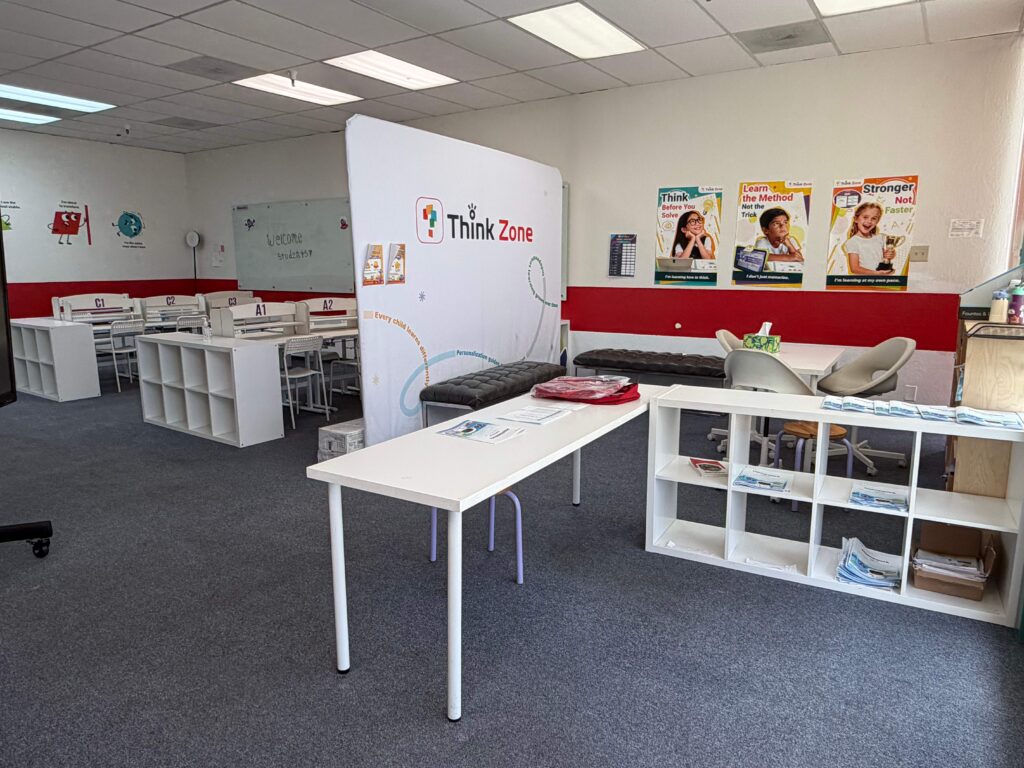
Think Zone’s math program is designed around the difference between a student’s grade and the student’s current learning level. The current K–G8 program begins with an adaptive assessment intended to identify mastered skills, skills that need support, and appropriate next steps. A personalized learning plan is then built around those results.
The learning cycle is not limited to assigning the next worksheet. Think Zone describes its current process as assess, teach, practice, correct, report, and adjust. Students work on paper, tutors use performance information to identify mistakes and provide support, parents receive progress updates, and the learning plan changes as skills become secure or continue to need review.
Internal Think Zone product materials describe the same approach in greater detail: assessment is used to identify current ability, mastered knowledge, knowledge gaps, and learning goals; the resulting plan determines individual content and pace; prior material is revisited through review; and progress monitoring informs later adjustments. The broader product positioning similarly emphasizes reducing unnecessary repetition, targeting specific gaps, and making learning progress visible to families.
This matters because two children in the same grade may need opposite next steps.
One fifth grader may need to revisit fraction equivalence before working on more advanced fraction operations.
Another fifth grader may already have those skills secure and need greater challenge.
Starting both students at the same worksheet because they share a grade label would miss that difference.
Think Zone’s current Math program covers K–G8 and its website lists eight Bay Area centers. The internal location analysis identifies the eight center areas as Cupertino, Sunnyvale, Union City, Fremont, Millbrae, Redwood City, Campbell, and Milpitas; the same document explicitly notes that nearby-school lists represent potential local schools rather than confirmed student sources.
CTA:
Not sure whether your child needs to review an earlier skill or is ready for more challenge? Start with a Think Zone Math Assessment to identify what is already secure, where the learning gap begins, and what should come next. The current assessment process maps K–G8 math skills and uses the results to build a personalized learning plan.
CTA Button: Schedule a Math Assessment
CTA Link Slug: /evaluation
Frequently Asked Questions
Why is my child struggling with math even though their grades are okay?
A course grade summarizes performance across assignments, tests, participation, and other school-based measures; it does not necessarily identify every prerequisite skill. Look at the child’s actual work and explanations. A student may perform well on familiar procedures while still having difficulty when a problem changes format or requires an earlier concept. A targeted assessment can help separate current-grade difficulty from a prerequisite gap. Think Zone’s assessment model is specifically designed to identify mastered skills and next-step needs rather than relying only on grade placement.
What are common math struggles by grade level?
In the early grades, parents may notice difficulty with number sense, place value, addition, subtraction, and representing problems. Grade 3 adds substantial work with multiplication, division, and early fractions. Grades 4 and 5 deepen fraction equivalence, decimals, and fraction operations. Grades 6 through 8 move into ratios, proportional relationships, and linear equations. These areas follow the California K–8 standards progression.
What math skills should a third grader understand?
California Grade 3 standards include interpreting multiplication and division, solving multiplication and division problems, understanding relationships between the operations, developing fluency within 100, and developing an understanding of fractions as numbers. A child should increasingly be able to explain what multiplication or division represents, not only recall answers.
Why does my fifth grader struggle so much with fractions?
One possible reason is that an earlier fraction idea is not yet secure. California Grade 4 standards develop fraction equivalence and ordering; Grade 5 then asks students to use equivalent fractions to add and subtract fractions with unlike denominators. If equivalence is unclear, the later procedure can feel arbitrary.
How can I tell whether my middle schooler is ready for algebra?
Look beyond arithmetic speed. By Grades 6 and 7, students are expected to reason with ratios, rates, percentages, and proportional relationships and to connect these ideas across tables, graphs, verbal descriptions, and equations. Grade 8 includes solving linear equations. Difficulty moving among these representations can signal a useful area for review before or during algebra work.
Should I give my child more worksheets when math is difficult?
More practice can help when the practice matches the actual need. It is less useful when the child is repeatedly practicing a procedure that depends on an earlier concept they do not understand. First identify whether the difficulty is calculation, conceptual understanding, mathematical language, representation, retention, or a prerequisite skill. Think Zone’s current program likewise describes practice as part of a cycle that includes assessment, teaching, correction, reporting, and adjustment rather than practice alone.
What should I do if my child understands math during a lesson but forgets it later?
Check whether the child can retrieve and explain the skill after the example is removed and after some time has passed. Review of earlier material can help distinguish a temporary retrieval problem from an underlying conceptual gap. Think Zone’s related guide on forgetting math discusses delayed review, prerequisite skills, and the difference between recognizing a method and retrieving it independently.