 By thinkzone

Your child reads every night. You practice together. Their teacher may even say they are trying hard. Yet reading still seems much harder for them than it should.
Maybe your child gets stuck on words other students seem to recognize quickly. Maybe they can read a page aloud but cannot tell you what it meant. Or maybe they understand a story perfectly when you read it to them, but struggle when they have to read the same kind of text independently.
For parents, all of these situations can feel like the same problem: “My child is struggling with reading.”
But they may have very different causes.
One useful way to understand reading difficulty is to look at the two broad skills that make reading comprehension possible: word recognition and language comprehension. Once you know which side is creating difficulty—or whether both need support—it becomes much easier to ask the right questions and choose the right kind of help.
What Are the 2 Essential Skills Behind Reading?
The Simple View of Reading, first proposed by researchers Philip Gough and William Tunmer, describes successful reading as the interaction of two broad abilities: decoding and language comprehension. In simplified form:
Word Recognition × Language Comprehension = Reading Comprehension
The multiplication sign matters. If one side is weak, overall reading comprehension can suffer even when the other side is strong.
Word recognition: Can your child read the words?
For a beginning reader, this includes connecting sounds with letters and letter patterns, blending sounds into words, and decoding unfamiliar words. With practice, many words become recognized quickly and automatically, so the child no longer has to labor through each one.
The Institute of Education Sciences recommends explicitly developing awareness of speech sounds and their links to letters, teaching children to decode and analyze word parts, and giving students practice reading connected text.
A child who has difficulty on this side may read slowly, hesitate frequently, misread words, guess instead of working through a word, or understand much more when someone else reads the text aloud.
Language comprehension: Does your child understand the language?
Language comprehension includes much more than knowing the definitions of individual words. It draws on vocabulary, sentence structure, background or world knowledge, the ability to connect ideas, and the ability to make reasonable inferences from what has been said or written. Reading Rockets describes these abilities as part of the language-comprehension side of successful reading.
A child can therefore pronounce a sentence accurately without fully understanding it.
Consider:
After weeks of drought, the reservoir had fallen to a critically low level.
A child may read every word correctly but not understand the sentence if drought, reservoir, or critically are unfamiliar.
That distinction—reading the words versus understanding the language—is the key idea parents should carry through the rest of this article.
What Are the 5 Most Common Causes of Reading Problems?
“Reading difficulty” is an outcome, not a precise explanation. Several skill gaps can produce similar-looking struggles.
Difficulty connecting sounds with print. Early reading depends partly on recognizing the sound structure of spoken words and learning how those sounds correspond to written letters and patterns. A child with weaknesses here may struggle to sound out unfamiliar words, confuse sound sequences, or rely heavily on guessing. IES identifies sound awareness and sound-letter connections as foundational areas for K–3 readers.
Weak or inefficient decoding. Some children know many letter-sound relationships but still have trouble combining them efficiently when reading real words, especially longer ones. This can continue beyond the primary grades: IES guidance for grades 4–9 specifically recommends building decoding skills for complex multisyllabic words in students who need reading intervention.
Slow, effortful word reading. Accuracy is not the whole story. A child might eventually read most words correctly but expend so much effort doing it that reading becomes slow and exhausting. IES treats purposeful fluency-building as an important area of intervention for older struggling readers, alongside decoding and comprehension.
Limited vocabulary or difficulty understanding complex language. If a child does not understand enough of the words and sentence structures in a passage, accurate pronunciation alone will not produce strong comprehension. IES recommendations address academic language and vocabulary in the early grades and word knowledge in grades 4–9.
Gaps in background or world knowledge. Reading becomes harder when a text assumes knowledge the reader does not yet have. A passage about ecosystems, the U.S. Constitution, or space exploration is easier to understand when the child already knows something about the topic. For grades 4–9, IES explicitly recommends building both world knowledge and word knowledge as part of comprehension support.
These causes also overlap. A child may have difficulty in more than one area, which is one reason a single overall reading score does not always tell parents what kind of support is needed.
What Are the 4 Common Types of Reading Difficulties?
There is no single official list of “four types” that should be treated as four clinical diagnoses. For parents, however, four observable reading patterns are useful for organizing what you see at home. The first three follow directly from the two dimensions of the Simple View; the fourth highlights fluency because effortful reading can be an important practical concern and is addressed separately in IES intervention guidance.
| Typical Signs | Possible Skill Gaps | What May Help |
|---|---|---|
| Word-reading difficulty: Understands stories when listening but struggles to read unfamiliar words independently | Phonological awareness, letter-sound knowledge, decoding, automatic word recognition | Explicit decoding instruction, work with sound-spelling patterns, appropriate connected-text practice |
| Comprehension difficulty: Reads many words accurately but cannot explain, summarize, or infer meaning | Vocabulary, oral language, sentence comprehension, background knowledge, inference | Vocabulary and knowledge building, discussion, questioning, summarizing, comprehension monitoring |
| Mixed difficulty: Struggles both to read words and to understand the message | Weaknesses on both sides of the Simple View | Targeted support addressing decoding and language comprehension rather than one generic reading activity |
| Fluency/automaticity bottleneck: Reading is mostly accurate but very slow, choppy, or effortful | Automatic word recognition and/or efficient integration of words into meaningful text | Purposeful supported reading and fluency practice while checking whether decoding or comprehension also needs attention |
A quick activity for parents: Compare listening with independent reading. Choose one age-appropriate passage and read it aloud to your child, then discuss what it means. On another similar passage, ask your child to read independently and answer comparable questions.
If comprehension is much stronger when you do the reading, word recognition may be limiting access to the text. If understanding is difficult in both conditions, language comprehension deserves closer attention. This is only an observation activity—not a diagnosis—but it applies the Simple View in a way parents can readily notice.
Why Do Some Children Read Words Correctly but Struggle With Comprehension?
This pattern can be particularly confusing because the child may sound like a good reader.
They pronounce the words. They finish the page. Their reading may even sound relatively fluent.
Then you ask, “What was that paragraph about?” and get a blank look.
Research confirms that this profile is real. A meta-analysis by Mercedes Spencer and Richard Wagner examined 86 studies involving children who showed poor reading comprehension despite adequate decoding. Across those studies, these children showed notable weaknesses in oral-language abilities such as vocabulary, listening comprehension, storytelling, and semantic or syntactic knowledge.
Imagine a fifth grader reading:
The colonists protested because they considered the new tax unjust.
They might decode colonists, protested, and unjust correctly. But comprehension still breaks down if they do not know what colonists are, what protest means in this context, what a tax is, or why a tax could be considered unfair.
That is why telling a child who has a comprehension-side difficulty simply to “read the passage again“ may not address the underlying problem.
The child may need more language and knowledge, not merely more exposure to the same words. IES guidance for older students reflects this distinction by recommending world and word knowledge, question asking and answering, identifying the gist of short sections, and monitoring comprehension.
How Can Parents Help a Child Who Struggles With Reading?
The best place to start is not, “How can I make my child read more?“
Start with:
“What part of reading is difficult for my child?”
Practice matters, but practice should give a child opportunities to strengthen the skill that actually needs work. IES recommendations distinguish foundational decoding instruction from comprehension-building practices for exactly this reason.
When decoding or word recognition is the main challenge, encourage attention to the letters and sound patterns in the word instead of immediately supplying the answer or asking the child to guess from a picture. For younger readers, practice can involve identifying sounds, connecting sounds to letters, blending, and reading words that use taught patterns. For older students, support may need to include breaking longer words into meaningful or pronounceable parts. These approaches align with IES recommendations for both early readers and students in grades 4–9.
Keep independent reading material manageable enough that the child can actually practice successful reading. Connected-text practice is valuable, but it works best as part of instruction rather than as a substitute for teaching the missing skill.
When language comprehension is the main challenge, make reading more conversational. Talk about unfamiliar words. Explain important background knowledge before reading. Pause after a paragraph and ask your child to tell you the “gist” in their own words. Ask questions such as, “Why did that happen?” or “What in the text makes you think that?” These practices mirror IES recommendations to build word and world knowledge, ask and answer questions, identify gist, and monitor understanding.
Short activity: The stop-and-summarize test. After one short paragraph, close the book and ask:
“Tell me what that paragraph said in one sentence.”
If your child cannot, reopen it together and investigate why. Was there a word they did not understand? A long sentence they could not unpack? Missing knowledge about the subject? Did they read so much of their attention went into figuring out the words that the meaning was lost?
That conversation is often more informative than simply marking an answer wrong.
For publication, the following visual can sit directly after this activity. It is deliberately a decision aid, not a diagnostic tool, and synthesizes the two-component logic of the Simple View.
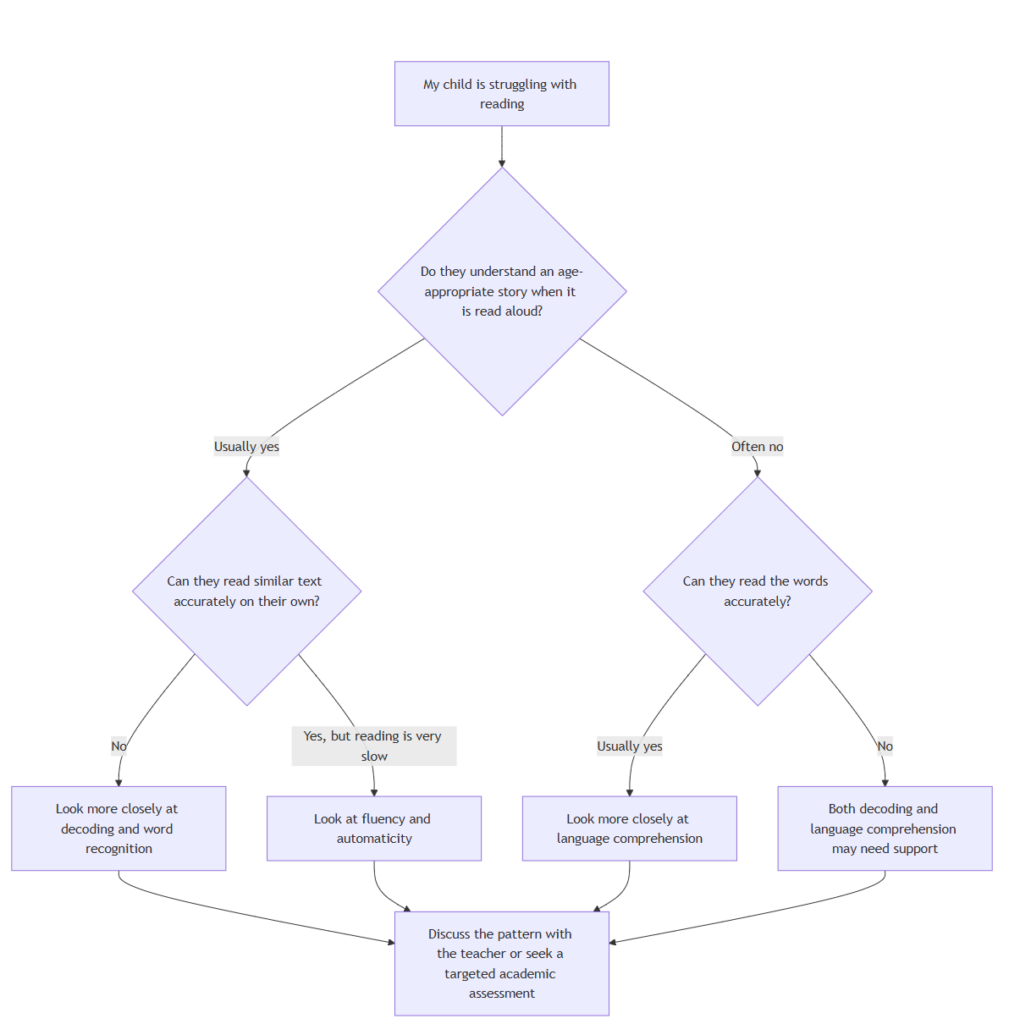
For a designed infographic version, use the heading “Where Might the Reading Struggle Be?” and keep the final box focused on assessment/support rather than a clinical label.
When Should You Seek Extra Reading Support?
One difficult book, one low test score, or an occasional homework battle does not tell you why a child is struggling.
Patterns are more useful.
Consider talking with your child’s teacher or seeking more targeted academic support when reading remains persistently effortful, your child routinely guesses or misreads words, comprehension is far stronger when someone reads aloud, your child can read accurately but rarely understands or remembers what they read, or progress remains limited despite regular instruction and practice.
The important question is not simply whether a child’s “reading level” is low. It is which underlying reading skills are strong and which need more support. Reading Rockets emphasizes that looking separately at decoding and language comprehension provides more useful instructional information than relying on a reading-comprehension score alone.
That is where a targeted academic assessment can be valuable.
At Think Zone, the goal is not to assume that every struggling reader needs the same program. An academic assessment can help identify the specific areas in which a student needs support so instruction can be more focused—whether that means strengthening foundational word-reading skills, comprehension-related skills, or a combination of the two.
This is academic support, not a clinical diagnosis. When a parent or school has concerns about a possible learning disability or another condition requiring formal diagnosis, the appropriate next step is a qualified school or clinical evaluation.
The bigger message for parents is reassuring: “struggling with reading” is not one single problem. Once you understand where the difficulty is occurring, you can make a much more informed decision about what kind of practice and support your child needs. The Simple View of Reading gives families a useful starting point for asking that question.
FAQ: Common Questions About Children Struggling With Reading
Why do kids struggle with reading even when they practice?
Because practice and instruction are not interchangeable. A child who cannot efficiently decode unfamiliar words may need explicit help developing decoding skills; simply spending more time in difficult books does not itself teach those skills. A child who reads accurately but lacks vocabulary or background knowledge may need language- and knowledge-building instead. IES guidance reflects this distinction by recommending specific decoding, fluency, and comprehension practices rather than one general intervention for all struggling readers.
Why are children reading less—and could that be causing the problem?
How often a child reads and how well a child reads are related questions, but they are not identical. In an individual child, reading less may sometimes be a consequence of reading feeling slow or difficult rather than the original cause. Instead of assuming the answer is simply “more books,” look at what happens when your child actually reads: Can they decode the words? Is reading unusually effortful? Do they understand what they read? That gives you more actionable information.
Can reading difficulties improve with the right support?
Reading skills can be taught and strengthened, and U.S. Department of Education practice guides identify evidence-based instructional approaches for foundational reading in K–3 and for students needing reading intervention in grades 4–9. The appropriate strategy depends on the child’s needs: decoding, fluency, language comprehension, or a combination.
How do I know whether my child needs a reading assessment?
Consider an assessment when a difficulty is persistent, interferes with schoolwork, causes significant frustration, or does not improve as expected with regular instruction. Rather than looking only for an overall score, ask whether the assessment helps clarify word recognition/decoding, fluency, and comprehension-related strengths and weaknesses. The Simple View is particularly useful because two children can struggle with overall reading comprehension for very different underlying reasons.
Is reading fluency the same as reading comprehension?
No. Fluency describes aspects of how accurately and efficiently connected text is read, while comprehension concerns understanding its meaning. They interact, but one does not guarantee the other. IES guidance for grades 4–9 treats decoding, fluency-building, and comprehension-building as related but distinct intervention priorities.
Suggested internal links: Link “academic assessment“to Think Zone’s assessment page; “reading comprehension” to an existing or future comprehension-focused article; “vocabulary” to Think Zone’s vocabulary/language-learning content; “decoding” or “foundational reading skills” to a phonics/reading-foundations article; and the final Think Zone mention to the most relevant reading tutoring or personalized learning service page. Anchor text should describe the destination naturally rather than repeatedly using commercial phrases such as “best reading tutor.”