 By thinkzone

You’re halfway through a bedtime story when your child asks, “What does that word mean?”
You explain it, turn the page, and keep reading. A few nights later, the same word comes up. Your child asks again.
Should you have spent more time on it? Asked them to repeat the definition? Written it down?
Teaching vocabulary through reading can start with something much smaller: choose a useful word, explain it briefly, and return to it once your child understands what is happening in the story. You can make room for word learning while still letting the book be a book.
Here’s what that can look like at home.
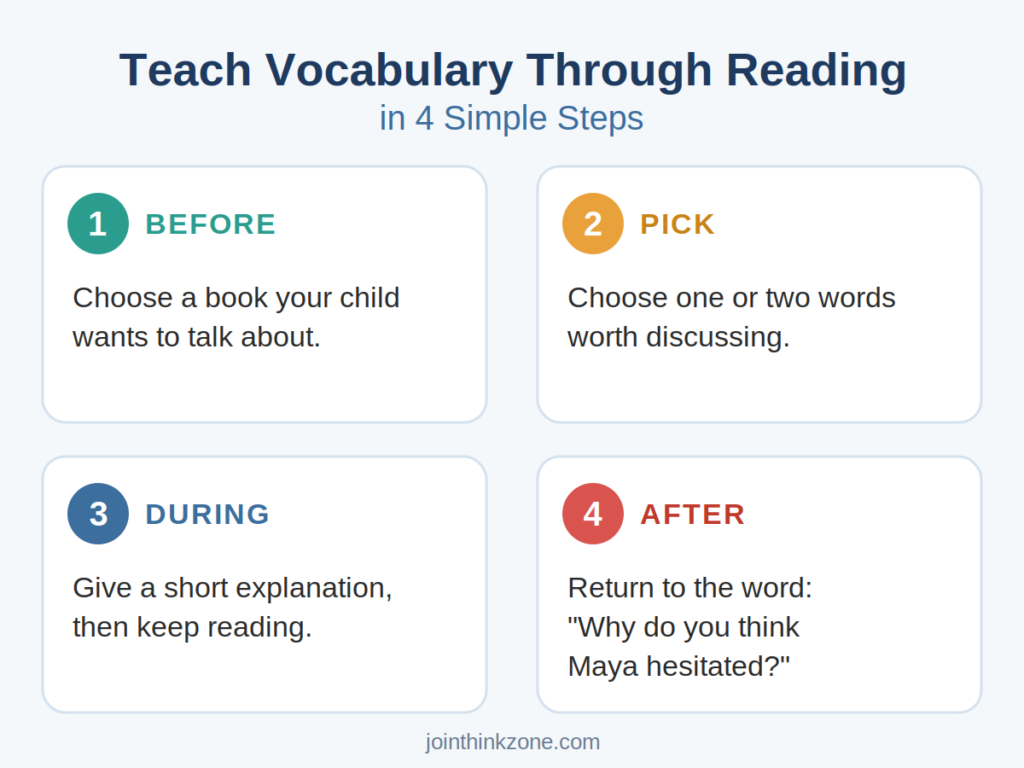
Before Reading: Choose a Book Your Child Wants to Talk About
Start with their interests. A child fascinated by animals may have plenty to say about a book on underground burrows. Another might prefer a funny story about a disastrous school trip.
Both give you something to work with. In the animal book, you might discuss shelter. In the school story, unexpected could be worth a closer look.
For a parent read-aloud, consider a book your child can follow and enjoy listening to, even if they cannot yet read every word independently. You can handle the printed words while they follow the characters, ideas, and conversation. Reading Rockets’ guidance on reading with your child explains how read-alouds introduce language children may encounter less often in everyday conversation.
If your child is doing the reading, choose something manageable for their current reading skills. When every sentence requires considerable effort, a long vocabulary discussion may be too much for that moment.
Pick One or Two Words Worth Discussing
One or two words is a manageable starting point for a short reading session—not a quota.
Look for a word that:
- Helps explain an important event or idea.
- Could appear in other books or conversations.
- You can explain using language your child already understands.
Vocabulary researchers Isabel Beck, Margaret McKeown, and Linda Kucan recommend considering a word’s usefulness, its relationship to familiar ideas, and its importance in the text when choosing words to teach. Their guidance also emphasizes giving children an opportunity to learn selected words well. Read their explanation in “Choosing Words to Teach.”
You do not need to preview every book. If an interesting word catches your attention while you read, use that opportunity.
During Reading: Give a Short Explanation and Keep Going
Imagine that you come across this sentence in a story. This is an illustrative example:
Maya hesitated at the edge of the diving board. She looked at the water and took a step back.
You might say:
“Hesitated means she paused because she wasn’t sure what to do. She hasn’t decided whether to jump.”
Then continue reading.
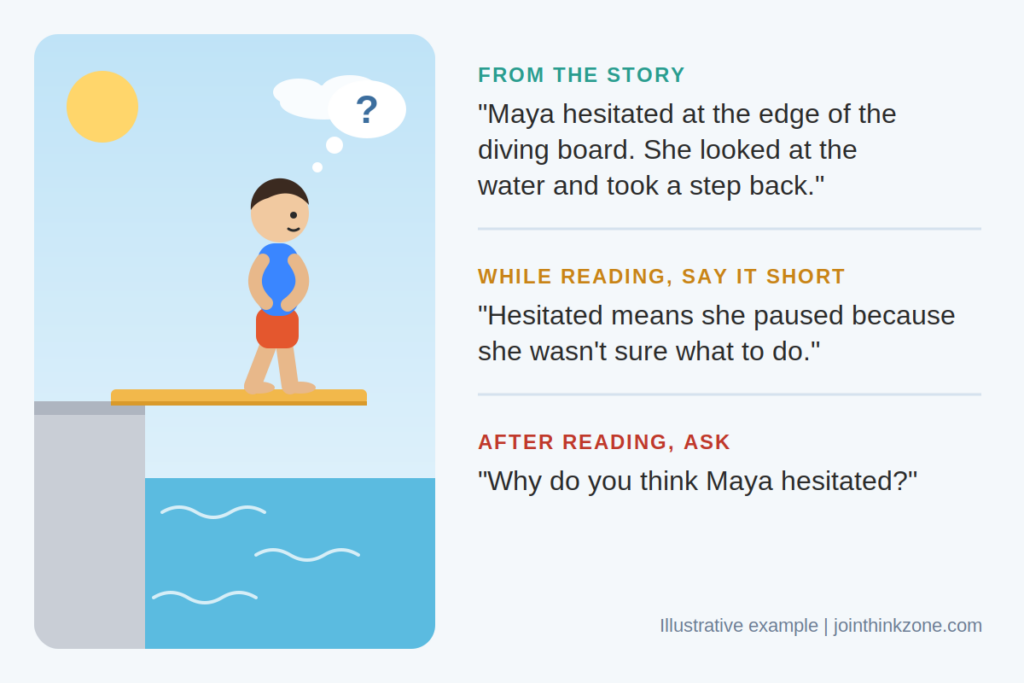
That explanation gives your child enough information to follow the scene. You can save a longer conversation for later, particularly if they are eager to find out whether Maya jumps.
In a Reading Rockets parent Q&A, literacy expert Sandra Wilborn recommends explaining unfamiliar words in simple terms, connecting them to something the child knows, and showing how they work in a sentence. She also encourages families to use those words again afterward. Watch her advice on learning words during read-alouds.
Explain the Meaning That Fits This Passage
Some words have several meanings. Explain the one your child needs right now.
If a character sits on a riverbank, for example, you might say:
“Here, the bank is the land along the edge of the river.”
There is no need to cover a financial bank at the same time unless your child brings it up.
If you are unsure about a word, say so and look it up together. Read the definition, then return to the sentence to check which meaning fits.
Use Context to Explore Meaning
Once your child has heard the word, the surrounding sentences can help you discuss it.
For hesitated, you could point out:
“She looks at the water and steps back. Those details help us understand why the author says she hesitated.”
Keep word meaning separate from identifying a printed word. When your child is reading, support them in attending to its letters and sounds, supplying help as needed. Pictures and story clues can support a conversation about meaning; avoid encouraging them to guess the printed word from the illustration.
After Reading: Return to What Happened
When you finish the scene or chapter, go back to your chosen word.
Instead of asking for a memorized definition, ask something about the character:
“Why do you think Maya hesitated?”
Your child might answer:
“She thought the water would be cold.”
That gives you an opening:
“That makes sense. She hesitated because she wasn’t sure she wanted to jump into cold water.”
Your child has connected the word to a possible reason for Maya’s behavior. They do not need to repeat your exact explanation.
If they cannot answer, offer a little support:
“Do you think she was ready to jump straight away, or was she still deciding?”
You can also reread the sentence together. There is no need to make the question harder until they get it right.
For a younger child, acting out a brief hesitation may be enough. For an older child, try comparing the author’s wording:
“What would change if the sentence said Maya rushed to the edge of the diving board?”
That keeps the discussion focused on how a word shapes the scene.
Use Nonfiction to Connect Words and Ideas
Stories are one place to build vocabulary. Informational books give you opportunities to explain words through diagrams, photographs, and real processes.
Suppose you are reading about animals that build shelters.
You could explain:
“A shelter is a place that gives protection. This burrow helps protect the rabbit from weather and other animals.”
Then look at the next example together:
“This animal uses a hollow tree. How does that work as a shelter?”
Your child can compare two examples of the same idea. You are also checking whether the word makes sense beyond the first picture.
When a topic interests your child, try another book about it. An animal encyclopedia, a short article, and a picture book about a woodland habitat may each give you another reason to discuss related words.
Let the questions guide you. If your child wants to know how a burrow stays dry, that conversation may be more useful than moving through a prepared vocabulary list.
Revisit Words Without Repeating the Same Quiz
When your child requests a favorite book again, take the opportunity to revisit a word you discussed before.
The conversation can change slightly
First reading: Explain what hesitated means.
Another reading: Ask what made Maya hesitate.
Later in the story: Notice whether Maya approaches the diving board differently.
Repeated interactive read-alouds can include brief word explanations and later discussions of those words in the story and in other situations. Literacy researchers Lea McGee and Judith Schickedanz describe this approach in their work on repeated interactive read-alouds.
At home, you can keep the revisit brief:
“There’s hesitated again. Remember what Maya did when she wasn’t sure?”
If your child remembers, move on. If they need a reminder, give one.
For a child reading independently, ask them to show you one sentence they found interesting or confusing. Read the surrounding paragraph together and discuss how the word works there. They do not need to record every unfamiliar word they encounter.
What If Your Child Dislikes the Interruptions?
Listen to that feedback.
Some children enjoy stopping to talk. Others want to hear what happens next. You can mark a page and return to it after the chapter, or simply explain an essential word in a few words without asking a question.
Try:
“Exhausted means very tired.”
Then carry on.
You can also let your child choose a word to discuss at the end. A word that sounds funny or describes a favorite character may interest them more than the one you selected.
On a tired evening, reading together may be enough. Vocabulary conversations can wait for a better moment.
Frequently Asked Questions
How many vocabulary words should I teach during reading?
For a short session, start with one or two useful words. Adjust to your child’s interest and the book. Treat this as a practical starting point, not a required number.
Should my child look up every unfamiliar word?
You can give a brief explanation when a word is needed to understand the passage. Use a dictionary together when the meaning is unclear, precision matters, or your child wants to investigate further.
Is rereading the same book useful for vocabulary?
Yes. A familiar book gives you another opportunity to revisit words and discuss how they relate to events or ideas. You can ask a different question or notice another example rather than repeat the same definition.
Can I teach vocabulary through reading if my child cannot read independently yet?
Yes. During a read-aloud, you read the text and discuss the language together. Your child can show understanding by talking, pointing, or acting something out.
What if my child understands a word but does not use it?
Keep offering meaningful examples and occasional opportunities to talk about it. Understanding a word in a familiar passage and choosing it independently are different demands. Avoid requiring your child to use every new word immediately.
Tonight, choose a book your child wants to hear. Notice one word that matters, give a short explanation, and keep reading. When you reach a natural stopping point, return to the sentence and talk about what that word helped you understand.