 By thinkzone

My Child Knows a Word but Can’t Use It—How Can I Help?
Your child gets generous right on a vocabulary quiz. They can tell you it means being willing to give or share.
Later, they write about a friend who shared her lunch:
What Does It Mean to “Know” a Word?
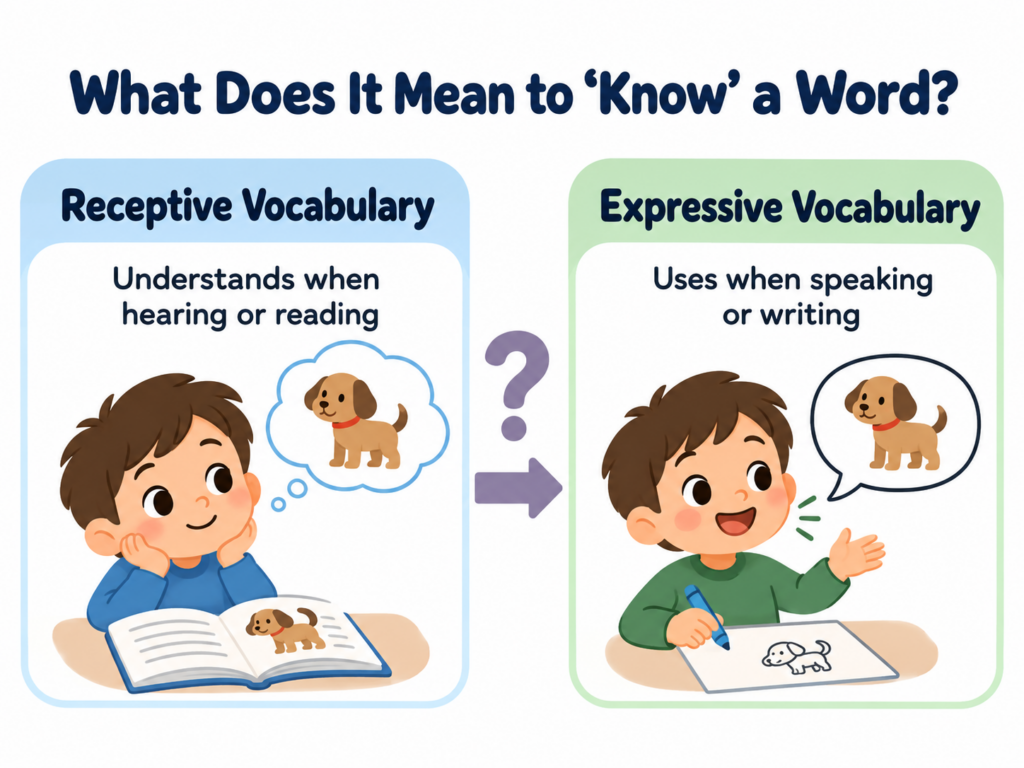
Knowing a word can mean several things. Your child might recognize its spelling, remember a definition, understand it in a familiar story, or use it comfortably in conversation. Those are related abilities, but they are not interchangeable.
Two useful terms are:
- Receptive vocabulary: Words a child understands when hearing or reading them.
- Expressive vocabulary: Words a child uses when speaking or writing.
A word can be easier to understand than to produce independently. Even adults sometimes recognize a word immediately but cannot think of it when they need it.
There is also a difference between remembering a definition and understanding when the word fits. A child who defines generous as “nice” may still need help seeing what makes sharing a lunch generous, while saying hello is simply friendly.
Before asking your child to use a word, explore what they understand about it.
Start With an Example, Not Another Definition
Suppose your child has learned reluctant. Instead of asking, “What does reluctant mean?” try:
“Maya wants to jump into the pool right away. Leo stands at the edge because the water looks cold. Who seems reluctant?”
Then ask what helped them decide.
If your child chooses Leo and explains his hesitation, you have something to build on. If they guess, give a clear explanation: “Reluctant means you don’t really want to do something, so you hesitate or hold back.”
A second example can show whether they understand more than the original situation:
“Could someone be reluctant to lend a favorite toy?”
Keep this brief. You are finding a useful starting point, not testing how many questions your child can answer. Literacy researchers Isabel Beck, Margaret McKeown, and Linda Kucan emphasize selecting words that connect to concepts children understand and that offer useful ways to describe their experiences. Read their guidance in “Choosing Words to Teach.”
Five Ways to Help Your Child Use New Vocabulary
1. Connect the Word to Something They Actually Want to Say
“Use disappointed in a sentence” gives your child two jobs: invent an idea and find a way to express it.
Start with an experience instead:
“You were looking forward to the picnic, and then it rained. How did you feel?”
If they say “bad,” you might respond:
“Disappointed could fit. You felt disappointed because something you hoped for didn’t happen.”
Then let them add their own detail. Perhaps they were disappointed about missing the playground, but happy to eat the picnic indoors.
Their idea gives the word a purpose. You do not need to insist that they repeat your sentence exactly.
Choose experiences your child is comfortable discussing. A funny mishap or a favorite game can work just as well as a difficult feeling.
2. Model a Sentence, Then Leave Room for Their Version
Give your child an example that shows how the word works in a sentence.
For prefer, you might say:
“I prefer the shady table because it’s cooler.”
Then ask:
“Which table would you choose?”
If they need help beginning, offer:
“I prefer ___ because ___.”
Sentence starters can provide a small amount of support:
| Word | Possible sentence starter |
| notice | I noticed ___ when ___. |
| solution | One solution would be to ___. |
| similar | These are similar because ___. |
| relieved | I felt relieved when ___. |
Use a starter when it helps, then try without it another time. Keep room for different sentence structures, too: “When I found my backpack, I felt relieved” works just as well.
3. Let Them Choose Between Words
An open request—”What’s a better word?”—can leave a child stuck. Offer a small choice that helps them think about meaning.
If they write “The character was mad,” ask:
“Was she annoyed by something small, or furious about what happened?”
Look back at the story together. Either word may need explanation, and the evidence should guide the choice.
You can also compare a fitting word with one that does not fit:
“Would you call someone generous because they shared their crayons, or because they finished their work quickly?”
Let your child explain. If neither of your suggestions matches what they mean, help them find another word.
The aim is accuracy. A longer or less familiar word is not automatically a better choice.
4. Rehearse One Sentence Before Writing It
When a child is trying to form an idea, spell words, and punctuate a sentence, a new vocabulary word can be difficult to work in.
Try talking through the idea first:
Parent: “What do you want to say about the bridge you built?”
Child: “It kept falling down.”
Parent: “Would unstable describe it? That means it wasn’t steady.”
Child: “Our bridge was unstable because the legs were different sizes.”
Now there is a sentence to write. Your child can change it as they go; the spoken version is a starting point.
For an existing draft, choose one sentence to revisit. Avoid circling every ordinary word and asking for an upgrade. Sometimes “said,” “went,” or “good” is exactly what the sentence needs.
5. Return to the Word in a Different Situation
After using solution to describe fixing a wobbly bridge, bring it back when a board-game piece goes missing:
“We need something to use instead. What’s a possible solution?”
Later, the word might appear in a math problem or a story about two friends disagreeing.
These situations let you discuss what stays the same: there is a problem, and someone is finding a way to address it.
Occasionally invite your child to think of the word without supplying it:
“What’s another way we could describe an answer to a problem?”
If they cannot recall it, give a clue or say the word. There is no need to keep them guessing.
What If the Sentence Is Almost Right?
Your child says:
“I was reluctanted to go.”
They have connected the word with a sensible situation. Help with the form without losing the conversation:
“You were reluctant to go. What made you change your mind?”
If they are writing, point out the adjustment directly:
“Here we say ‘was reluctant,’ without adding ‘-ed.’ Let’s read the sentence again.”
Sometimes the meaning needs attention instead. If your child says, “The puzzle was generous because it had lots of pieces,” you can explain:
“Generous usually describes giving or sharing more than expected. Do you mean the puzzle was large, or that someone was generous when they gave it to you?”
Treat the attempt as information about what needs explaining next.
Match the Help to the Difficulty
Notice where your child gets stuck before choosing an activity.
| What you notice | A useful next step |
| They repeat a definition but cannot identify an example. | Explain the meaning through a familiar situation, then compare examples. |
| They choose the right example but cannot make a sentence. | Model a sentence and offer a short starter. |
| They use the word comfortably in conversation but not in writing. | Rehearse one sentence aloud before writing. |
| They use it only in the original book or homework example. | Try a different situation where the same meaning applies. |
| They reach for an impressive word that changes their intended meaning. | Ask what they want to say, then choose the most accurate wording. |
You do not need to work through every row. Start with the difficulty you can actually see.
How Will You Know Your Child Is Making Progress?
Listen for a change in how much support they need.
Perhaps your child first uses relieved after you explain it. Another day, they use it with a sentence starter. Later, they tell you they felt relieved when they found a missing library book.
You can acknowledge that naturally:
“Relieved fits—you were worried, and then you knew the book was safe.”
Also notice when your child asks a thoughtful question: “Can a place be generous, or only a person?” That gives you an opportunity to explore meaning together.
Avoid making every conversation a check for target words. Your child should still be able to tell you about their day without wondering whether they are choosing the vocabulary you want.
When Should You Ask the Teacher for Help?
If the difficulty keeps showing up in schoolwork, bring a few examples to the teacher.
You might say:
“She can explain the vocabulary words from the story, but she finds it hard to use them in her own sentences. Does that happen in class, too?”
Ask whether your child needs support with word meanings, sentence construction, recalling words, or developing ideas. Those call for different kinds of practice.
Difficulty using a newly taught word, by itself, does not establish a language problem. If your child also regularly struggles to find familiar everyday words or communicate basic ideas, share that broader pattern with the teacher or a speech-language pathologist.
Frequently Asked Questions
Why does my child know a word but can’t use it in a sentence?
Remembering a definition does not necessarily show when or how to use the word. Try a familiar example, discuss why the word fits, and model a sentence before asking your child to create one independently.
Should I make my child use every new word in writing?
No. Choose words that fit what they want to communicate. Start with conversation if writing adds too much difficulty, then work on one meaningful sentence rather than requiring every new word in a paragraph.
What if my child always uses simple words?
Simple words are often appropriate. Offer a more precise option when it adds meaning, such as disappointed instead of bad. Let your child decide whether that word accurately describes the idea.
Are flashcards useful for helping children use vocabulary?
They can help review meanings, but add something beyond recalling a definition. Ask for an example, compare two situations, or use the word in a short conversation. Those tasks give your child practice choosing and applying it.
Should I correct every vocabulary mistake?
Respond when an explanation would help, but keep the original conversation in view. You can model the correct form and continue talking. During writing practice, choose one or two points to discuss rather than correcting everything at once.
Give the Word Somewhere to Go
The next time your child knows a word but can’t use it, start with what they want to say
Ask about the friend who shared lunch, the game that was frustrating, or the moment they felt relieved. Offer a word that fits, show how it works, and leave room for their version.
A useful next step might be just one sentence they understand and mean.